
Play Aviator Now!
Home → How to Play
How to Play Aviator
How a round of Aviator works
Aviator is a crash game developed by Spribe in 2019 with a theoretical RTP of 97.00%. This percentage represents the house edge of 3.00% over millions of rounds, ensuring long-term mathematical fairness for players who understand the mechanics. The round ends when the multiplier crashes, requiring timely cashouts to secure any profit before the plane flies away.
Aviator game parameters
| Studio | Spribe |
| Released | 2019 |
| RTP | 97.00% |
| Max multiplier | x1,000,000 |
| Bet range | 0.10 EUR / USD / GBP (varies by operator) - 100 EUR / USD / GBP (varies by operator) |
The provably fair system uses SHA-256 hashing with server seeds and client seeds to verify each outcome independently. This cryptographic method allows users to audit results, confirming that neither Spribe nor operators manipulate the flight path or crash point during gameplay sessions. Such transparency builds trust in the integrity of every single round played on the platform.
Unlike traditional slots, Aviator features no reels or paylines, relying instead on a rising multiplier curve that determines wins. Players can engage in dual-bet mode, placing two simultaneous wagers to hedge risks while watching the multiplier climb. This unique structure demands constant attention, as the entire session revolves around predicting the exact moment to exit.
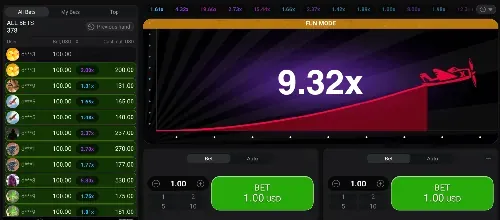
Placing your first bet
The welcome bonus offers a 300% match up to €2,000 plus 100 free spins for new registrations. These funds must be wagered according to specific terms, where the bonus amount is subject to rollover requirements before withdrawal eligibility activates. Understanding these conditions is crucial for managing bankroll effectively during initial gameplay sessions.
Spribe’s Aviator allows dual bets, enabling players to place two separate wagers in one round for strategic flexibility. One bet might auto-cashout at lower multipliers while the second targets higher risks, optimizing potential returns from the 97.00% RTP configuration. This feature distinguishes it from simpler games like Dice, which lacks such complex betting layers.
Minimum stakes typically start low, allowing beginners to test strategies without risking significant capital against the 3.00% house edge. Operators may adjust RTP settings to 96% or 94%, directly impacting long-term expected value for high-volume players. Always check current configurations to ensure optimal play conditions align with personal risk tolerance levels.
Watching the multiplier climb
The multiplier rises continuously as the virtual plane ascends, creating tension until the unpredictable crash event terminates the round. Players must monitor this climb closely, as waiting too long results in total loss of the placed stake. The maximum win cap stands at x1,000,000, offering substantial rewards for precise timing decisions made during peak volatility phases.
Auto cashout functionality lets users set predetermined multipliers, removing emotional bias from rapid decision-making processes during intense climbs. This tool ensures consistent execution of strategies, particularly useful when tracking the 97.00% theoretical return over extended periods. Automated exits help maintain discipline, preventing greed-driven losses when the multiplier approaches critical thresholds.
Comparing Aviator to other titles reveals distinct advantages; for instance, Dice offers adjustable volatility but lacks the visual progression of a climbing multiplier. The live bet feed shows real-time wagers from other participants, adding social context to the solitary act of watching numbers rise. This communal aspect enhances engagement without altering the underlying mathematical probabilities governing each outcome.
Cashing out in time
Cash out means securing the current multiplier value before the plane disappears, locking in profits against the inevitable crash. Missing this window results in forfeiting the entire stake, highlighting the importance of disciplined exit strategies in Aviator. Successful players often use partial cashouts to balance risk management with the pursuit of higher multipliers.
The theoretical RTP of 97.00% assumes optimal play over infinite rounds, meaning individual sessions will vary significantly due to variance. Players should expect fluctuations, understanding that short-term losses are normal within the framework of the 3.00% house edge. Consistent application of proven tactics helps mitigate downside risk while maximizing exposure to winning multipliers.
Dual-bet mode provides a hedge mechanism, allowing one stake to secure early gains while the other chases larger multipliers. This approach diversifies outcomes within a single round, smoothing equity curves compared to single-stake strategies found in games like Dice. By splitting bets, players can cover both conservative and aggressive scenarios simultaneously.
What ends the round
A round concludes instantly when the multiplier crashes, terminating all active bets and resetting the cycle for new participants. This abrupt end prevents carry-over effects, ensuring each Aviator round operates independently with fresh random seeds. The crash point is determined cryptographically, maintaining fairness through SHA-256 verification protocols used by Spribe.
Certification by iTech Labs and BMM Testlabs guarantees that the crash algorithm meets rigorous standards for randomness and integrity. These audits confirm that the 97.00% RTP holds true over vast datasets, protecting players from manipulated outcomes. Such third-party validation is essential for maintaining trust in online gambling environments.
Maximum wins are capped at x1,000,000, limiting payouts regardless of how high the multiplier climbs before crashing. This cap protects operator solvency while still offering life-changing sums for lucky players who time their exits perfectly. Understanding this limit helps manage expectations, especially when comparing against games with uncapped potential.
Aviator: key facts
| Parameter | Value |
|---|---|
| Game | Aviator |
| Studio | Spribe |
| Released | 2019 |
| RTP | 97.00% |
| House edge | 3.00% |
| Max win | x1,000,000 |
Difficulty levels and settings
The game Aviator offers a straightforward configuration where players can toggle the auto cashout feature to automate their exit strategy. This setting allows users to define a specific multiplier threshold, ensuring that funds are secured before the plane flies away unexpectedly. Such automation reduces emotional decision-making during high-volatility rounds in Aviator.
Players may choose between single-bet mode or dual-bet mode within Aviator, allowing for two simultaneous wagers per round. The second bet often utilizes the auto cashout function set at a conservative value to cover the stake of the first wager. This strategic layering helps manage risk while participating in the fast-paced environment of Aviator.
The interface provides clear visual cues for the rising multiplier, which starts at x1.00 and increases until the crash point. Players must manually click the cashout button or rely on their pre-set automated limits to secure winnings. Understanding these mechanics is essential for anyone wishing to participate effectively in Aviator.
Bet limits per round
The minimum stake required to enter a round in Aviator is typically 0.20 €, allowing for low-risk entry points. This low barrier ensures that casual players can test strategies without committing significant capital to each individual round. Such accessibility makes Aviator suitable for players with varying budget sizes and risk appetites.
The maximum bet allowed per round in Aviator is generally capped at 100 €, limiting exposure during high-multiplier phases. While this limit prevents excessive losses on a single round, it also caps the potential absolute win from a single wager. Players seeking higher stakes must split their total bankroll across multiple bets within the same round of Aviator.
Calculating the potential return requires multiplying the stake by the cashout multiplier before the crash occurs. For instance, a 10 € bet cashed out at x50 yields a 500 € return, demonstrating the game's high-variance nature. This calculation applies to every round in Aviator, regardless of whether the player uses manual or auto modes.
Reading the interface
The central element of the Aviator interface is the graph displaying the rising multiplier, which updates in real-time. This visual representation allows players to monitor the current potential payout as the virtual plane ascends into the sky. Observing this trend is critical for deciding when to execute a cashout action in Aviator.
Above the main graph, the live bet feed displays other players' current stakes and their cashout points simultaneously. This multiplayer aspect adds a social dimension, showing how others react to the rising multiplier in real-time. Analyzing this feed can provide psychological insights but should not replace personal strategy in Aviator.
The bottom section contains the betting controls, including buttons for placing bets and toggling auto features. These controls are designed for quick interaction, reflecting the fast pace of each round in Aviator. Familiarity with this layout ensures that players can react swiftly to changing multiplier values during gameplay.
Round history and statistics
The round history panel in Aviator displays the final multiplier values of the previous twenty to fifty rounds. This data allows players to identify trends, such as frequent low multipliers or rare high-value crashes. Tracking these outcomes helps inform future betting decisions within the context of Aviator's random number generation.
Aviator operates on a theoretical Return to Player (RTP) of 97.00%, meaning the house edge is exactly 3.00%. This percentage represents the long-term expected loss relative to total wagers over hundreds of thousands of rounds. Short-term results in Aviator will always deviate significantly from this theoretical average due to variance.
The statistics do not predict future outcomes because each round is independent and generated via Provably Fair algorithms. Past crashes do not influence the probability of the next round's result in Aviator. Relying on historical data for prediction is mathematically unsound, as the SHA-256 seed combination ensures randomness.
Provably fair verification
Aviator utilizes a Provably Fair system based on SHA-256 hashing to ensure transparency and prevent manipulation. This cryptographic method combines a server seed with multiple client seeds and a nonce to generate each round's outcome. Players can verify the fairness of any past round using these published hash values in Aviator.
The verification process allows users to input the server seed, client seeds, and nonce into an external calculator. If the resulting hash matches the one displayed in the round history, the outcome was indeed predetermined and unaltered. This audit trail provides assurance regarding the integrity of Aviator's gaming engine.
Certification bodies such as iTech Labs and BMM Testlabs have audited the underlying technology powering Aviator. These third-party validations confirm that the RTP calculations and random number generation meet industry standards. Such certifications reinforce trust in the mathematical soundness of Aviator for international players.
Manual play versus automation
Aviator allows players to choose between manual cash out and automated features, a distinction critical for managing the rising multiplier that defines each round. The dual-bet mode lets users set an auto cashout parameter while manually controlling a second stake, offering flexibility in how the plane flies away during gameplay. This setup requires constant attention because the crash point is unpredictable, unlike slots where outcomes are determined by static reels.
The auto cashout feature in Aviator triggers when the multiplier reaches a specific value, removing the need for human reaction time against the rising curve. Spribe designed this tool to help players lock in profits before the plane disappears, which is essential given the game’s fast-paced nature and potential for rapid losses. Users must configure these limits carefully, as missing the threshold results in an automatic loss of the entire stake for that particular round.
Comparing Aviator to Tower Rush by Galaxsys highlights different risk profiles, though both rely on multipliers rather than traditional slot mechanics. Tower Rush offers a max win of 100x, whereas Aviator theoretically allows payouts up to x1,000,000, demanding stricter discipline from those using automation tools. Players should note that higher multipliers increase variance, making fixed auto-cashout values more suitable for conservative bankroll management strategies.
Common beginner errors
A frequent mistake involves chasing losses in Aviator by increasing stakes after a crash, ignoring the fact that the theoretical RTP remains at 97.00% over long runs. Since each round is independent and governed by SHA-256 hashing, previous outcomes do not influence future multipliers, making recovery bets statistically unsound for new players. This behavior often leads to rapid depletion of funds because the house edge of 3.00% accumulates with every failed attempt to recoup losses.
Another error is misunderstanding the provably fair system, assuming that published hashes guarantee immediate wins rather than verifying round integrity post-game. Aviator uses server seeds combined with client seeds and a nonce to ensure transparency, but this technical detail does not alter the negative expectation of the game. Beginners who focus on fairness verification instead of bankroll management often neglect the fundamental risk associated with the rising multiplier mechanic.
Players also frequently ignore operator-specific RTP configurations, believing the advertised 97.00% applies universally across all casino platforms hosting Spribe’s title. Some operators may configure lower rates such as 96% or even 94%, which significantly impacts long-term returns compared to the theoretical maximum. This variation means that the same game can yield different results depending on the venue, requiring careful selection of platforms with favorable terms.
Pacing your rounds
Managing the speed of play in Aviator is crucial because the rising multiplier creates a psychological pressure to act quickly before the plane flies away. Unlike Tower Rush, which has a lower max win of 100x, Aviator’s potential for x1,000,000 encourages faster betting cycles that can deplete balances rapidly if unchecked. Slowing down allows players to analyze patterns without falling into the trap of impulsive decisions driven by the adrenaline of the live bet feed.
The presence of multiplayer live bet feeds in Aviator can disrupt pacing, as seeing others win large amounts may tempt players to increase their stake size unnecessarily. These social elements do not affect the mathematical outcome of any single round, yet they create a false sense of opportunity that contradicts the game’s random nature. Maintaining a steady rhythm helps players stick to their predetermined cash-out points rather than reacting emotionally to external stimuli.
Time spent per round in Aviator varies based on whether players use auto cashout or manual intervention, with manual play typically taking longer due to decision latency. Each round lasts only until the crash, meaning many rounds can occur in a short period, amplifying the impact of the 3.00% house edge over time. Players should calculate their expected turnover based on round frequency to ensure they remain within their budgeted session limits effectively.
Managing a session bankroll
Setting a strict bankroll limit for Aviator sessions prevents emotional spending during the volatile swings inherent in crash games like those developed by Spribe. With a theoretical return of 97.00%, players should expect to lose approximately 3% of their total wagered amount over extended periods of play. This statistical reality necessitates treating losses as the cost of entertainment rather than an investment strategy, ensuring financial stability outside the gaming environment.
Using the dual-bet mode in Aviator allows for strategic allocation of funds, where one stake might target small multipliers while another aims for larger payouts. This approach diversifies risk within a single round, potentially offsetting losses on one bet with gains on the other, provided the auto cashout settings are correctly configured. However, it also doubles the exposure to the house edge, requiring proportional adjustments to the overall session budget to maintain sustainability.
Comparing Aviator’s volatility to simpler games like Tower Rush reveals why bankroll management is more complex for titles with higher max win caps. While Tower Rush limits wins to 100x, Aviator’s potential for x1,000,000 introduces extreme variance that can wipe out small balances in minutes if stakes are too high. Players must size their bets relative to their total bankroll, ensuring that no single round poses a threat to their ability to continue playing responsibly.
What experience actually changes
Experienced players recognize that Aviator’s provably fair mechanism via SHA-256 ensures transparency but does not provide any advantage in predicting crash points. Understanding that server seeds and client seeds combine randomly helps veterans avoid superstitious betting patterns that plague beginners seeking control over chance events. This knowledge shifts focus from trying to beat the algorithm to optimizing stake sizes and cash-out timings for consistent long-term engagement.
Seasoned users leverage the auto cashout feature more effectively by setting multiple thresholds tailored to different market conditions observed in the live bet feed. Unlike novices who chase high multipliers, experts often secure smaller, frequent wins to mitigate the impact of the 3.00% house edge over hundreds of rounds. This disciplined approach aligns with the theoretical RTP of 97.00%, allowing for sustained play despite the inherent randomness of each individual round.
Mastery of Aviator involves accepting that operator-configured RTP variations, such as 96% or 94%, cannot be overcome through skill alone, regardless of player expertise. While Spribe’s certification by iTech Labs and BMM Testlabs guarantees technical fairness, the actual return depends heavily on the platform chosen by the user. Veterans prioritize venues with higher RTP configurations, recognizing that minor percentage differences compound significantly over thousands of rounds played.
DemoRTP & VolatilityHow to PlayAuto CashoutStrategyBonusesMobileDownload & AppMax WinSimilar GamesReviewFAQSitemap
Aviator 2026